
Stepper Motors vs. Servo Motors: Why One Has Power Rating and the Other Doesn’t
When first learning about stepper motors and servo motors in mechanical design, many people ask: Since both drive loads to rotate, why don’t steppers have a “power” rating, while servos clearly specify power (e.g., 400W, 750W, 1kW)? The answer is simple. Stepper motors focus on pulse-based positioning; their output is intermittent and variable, with no stable power to define. So they are rated by torque and speed instead of power. Servo motors rely on closed-loop power control and can output torque and energy continuously and smoothly, so they must show rated power.
I. Working Principles: Different Core Goals
A stepper motor is an open-loop control device. It rotates a fixed angle for each input pulse. The controller does not need the motor’s actual position; it only sends pulses. Its control core is “pulse-to-angle correspondence,” focusing on “steps taken and position reached,” making it a positioning-type actuator.
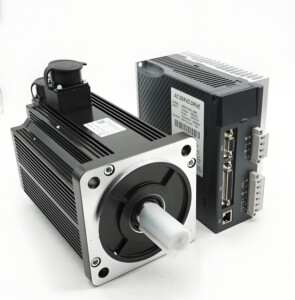
A servo motor uses a closed-loop control system with an encoder or rotation detector to monitor speed, angle, and output torque in real time. The controller continuously adjusts the output based on feedback to keep the motor running stably at the target state. Servo systems support precise control of speed, position, and torque loops, acting as a stable power source for continuous power output.
II. Why Stepper Motors Are Not Rated by Power
Theoretically, output power of any motor equals torque multiplied by angular velocity. However, the output characteristics of stepper motors make a fixed power rating meaningless:
Stepper torque drops rapidly as speed increases — high torque at low speed, sharp decline at high speed, resulting in unstable power.
Stepper operation is pulse-based, not continuous and smooth; it moves in start-stop, step-by-step motions.
The key for selection is whether it can drive the load and position accurately, not how many watts it outputs.
For these reasons, stepper motors are labeled with holding torque (N·m) and maximum speed (r/min) instead of power. In engineering selection, torque is the main criterion for meeting load requirements.
III. Why Servo Motors Must Be Rated by Power
Unlike steppers, servo motors can output stable torque and speed continuously under closed-loop control, so they have a clear rated power. Power directly indicates the load capacity and sustainable energy output. Higher power means the servo can maintain sufficient torque at higher speeds.
In servo selection, calculate the required output power on the mechanical shaft (P = T × ω), then match the motor power level and select the model. Rated power is critical for evaluating performance and system matching.
IV. Selection and Application Differences
1. Different Selection Logic
Stepper motors: Focus on load drivability and positioning accuracy. Key factors: load inertia, required torque, operating speed, acceleration/deceleration time, and microstepping control.
Servo motors: Focus on stable speed and torque output. Key factors: rated power, rated speed, maximum torque, acceleration performance, and feedback precision.
2. Different Application Scenarios
Stepper motors: Used for high positioning accuracy and low speed requirements, such as dispensers, 3D printers, labeling machines, test fixtures, indexing tables, and marking equipment. They are simple, easy to control, and low-cost.
Servo motors: Used for high speed, high precision, heavy load, and continuous stable operation, such as automated production lines, machining center spindles, handling robots, robot joints, and conveyor systems.
3. Control and Feedback
Stepper motors: Open-loop, no position feedback; may lose steps under excessive load.
Servo motors: Encoder feedback, error compensation, smooth operation, almost no step loss.
4. Cost and Complexity
Stepper systems: Low cost, simple control.
Servo systems: Higher cost, more complex commissioning, but stronger performance and higher efficiency.
V. Summary
A stepper motor is a positioning tool, while a servo motor is a power system. One ensures precise positioning; the other provides continuous driving. In selection, steppers are judged by torque and servos by power — this is their essential difference.