
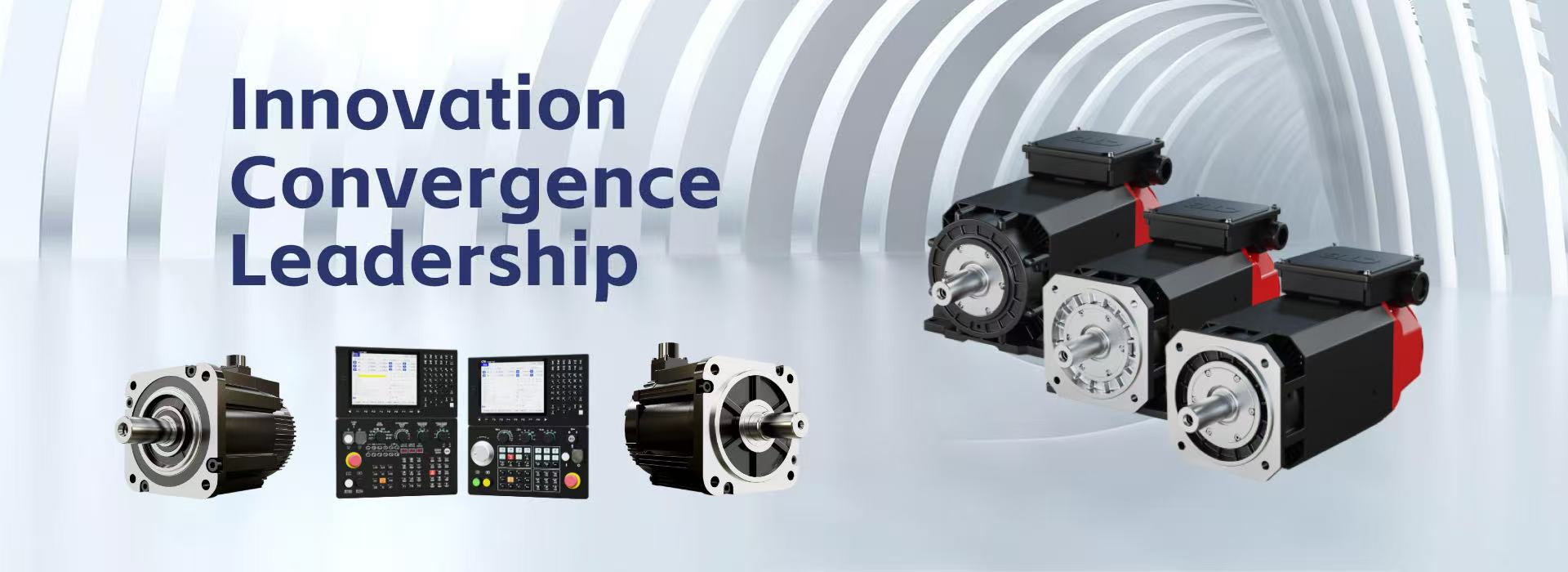
When people hear the word “electric motor”, their first thought is probably “just a small spinning motor, right?”. Truth be told, behind the buzzing vibration of electric toothbrushes at home, the precise movement of robotic arms in factories, and the high-speed performance of new energy vehicles, electric motors are all working silently. Today, let’s talk about several core members of the motor family — AC motors, DC motors, stepper motors and servo motors — to explore their unique strengths and the applications they excel in.
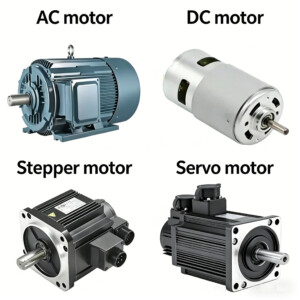
- AC Motor
The AC motor is definitely a “veteran” and a “model worker” of the motor family: sturdy, durable, cost-effective, and versatile.Features: Its biggest advantage is that it can run directly on household alternating current without additional rectification equipment.
Applications: AC motors are divided into two main categories: asynchronous motors and synchronous motors. Asynchronous motors are the most common in daily life, powering air conditioner outdoor units, washing machine drums, and electric fans. Household appliances prefer AC motors due to their simple structure — consisting of only a stator and a rotor with few complex components, making them easy to repair. They also handle heavy loads reliably, such as water pumps and fans in industrial plants that run continuously all day. Synchronous motors offer even greater performance with extremely stable rotational speed, making them the ideal choice for high-precision equipment like generators and large rolling mills.
However, AC motors have a minor drawback: limited speed regulation flexibility. In the past, complex speed control devices were required to adjust their speed freely. Fortunately, with the maturity of frequency converter technology, this problem has been effectively solved.
- DC Motor
DC motors follow a route of “precision and flexibility”.Features: They require direct current to operate. Although they need a rectifier to convert AC to DC, they boast superior speed regulation — smooth, responsive, and easily adjustable to any desired speed.
Applications: The small motors in toy racing cars, powered by rechargeable batteries, are typical DC motors. They are also widely used in electric toy cars and electric shavers. In industry, DC motors were once dominant, powering old trams and subway trains.
Yet DC motors have a critical weakness: they contain commutators and brushes, which are wearing parts that erode over time and generate sparks. This requires frequent maintenance and restricts their use in explosion-proof environments. As a result, they are gradually being replaced by servo motors and variable-frequency AC motors in many fields. However, they still hold a place in small devices that demand high speed controllability and convenient maintenance.
- Stepper Motor
Stepper motors are like “perfectionists” — moving step by step with absolute stability.Features: Similar to climbing stairs with fixed steps, each pulse signal causes the motor to rotate a fixed angle. When the pulse stops, the motor brakes immediately and holds position firmly.
Applications: This precise positioning capability makes them “positioning experts” in automation equipment. They drive the print head movement in printers, the tool path control in engraving machines, and the layer-by-layer material extrusion in 3D printers.
Advantages: Simple control without complex feedback systems, low cost, high positioning accuracy, and fast start-stop response.Limitations: Relatively low torque, prone to step loss under heavy loads, and reduced torque at high speeds. Therefore, they are best suited for low-speed, light-load applications requiring high positioning precision, rather than heavy-duty or high-speed tasks.
- Servo Motor
Servo motors are the “high-end top performers” of the motor family, combining the best features of other motors: precise positioning like stepper motors, flexible speed control like DC motors, along with high torque and fast response — a true all-rounder.
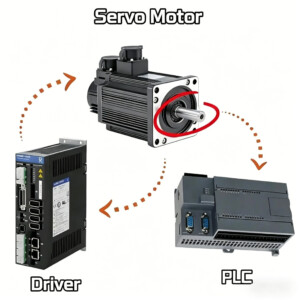
Features: Their exceptional performance comes from built-in “eyes” and “brain”: an encoder and a servo driver. The encoder acts as eyes, monitoring the motor’s speed and position in real time and sending data to the driver. The driver functions as the brain, adjusting the motor’s operation precisely to form a closed-loop control system.
In short, it rotates exactly to the commanded angle, maintains a steady speed regardless of load changes, and responds instantly to adjustments.
Applications: This outstanding performance makes them highly desirable for high-end automation equipment. They power the flexible, precise joints of industrial robots, the spindles and tool posts of CNC machine tools for precision machining, drone propellers, and assembly lines for sophisticated electronic devices.
Naturally, as a premium product, servo motors are more expensive and complex to control. However, they deliver the best cost-performance ratio in applications requiring high precision, responsiveness, and stability.
The motor family includes far more members than these. With technological advancement, more efficient and intelligent motors will emerge. Regardless of future innovations, their core mission remains the same: converting electrical energy into mechanical energy to power our daily lives and drive the progress of society.